The body of the dragon consists of flat cells, each individually painted and supported by a feather-tipped bamboo balance rod.
   The amazing part is how well they fly. Each cell provides lift so that the combined power dozens of cells creates an undulating train in the sky. You can actually hold the head in your hand while the body supports it, or launch the entire creation into the air. And of course, you can also display your Chinese treasure indoors.
или еще вариант попроще
By Dan Beard
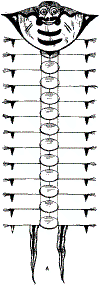 Fig. 27. The Chinese Dragon Kite.
This kite is a most resplendent affair, and glitters in the sunlight as if it were covered with jewels. It is rather complicated to look at, but not very difficult to make. The one I have before me was made in China.
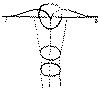 Fig. 25. Fig. 25.
The top or horizontal stick (Fig. 25, 1-2) is three feet long, half an inch wide, and one-eighth inch thick. The face can be simplified by using a loop, as in the man kite. Two more loops, as shown in the diagram, will serve as frames for the wings.
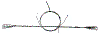 Fig. 26. Fig. 26.
Paper is pasted upon this, and hangs loose like an apron in front below the cross-stick (1-2). Cut the paper long enough to cover the first disk of the tail-piece, as shown in the finished kite, Fig. 27.
The head-piece is ornamented with brilliant colon, bits of looking-glass pasted on or attached with strings, so that they dangle loosely, etc.; this makes the top rather heavy, as, in fact, it ought to be, for then it serves to balance the tail, which, in this instance, is a succession of circular kites, ten inches in diameter, and thirteen in number, connected with one another by strings.
Attached to each of these paper disks is a slender piece of reed or grass with a tufted head; a similar tuft is fastened by a string to the opposite end to balance it. The breast-band is made like that upon an ordinary kite; the cross-strings, being attached to the face at the top and bottom, intersect each other about opposite a point between the eyes.
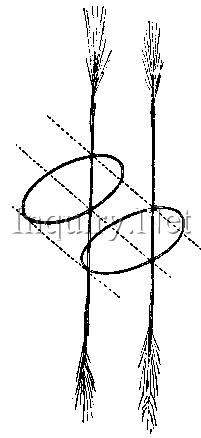
Fig. 26 represents the top view of a single disk, showing where the reeds and string are attached. Fig. 27 shows a side view of two disks, and the way in which they are connected by strings, six and a half inches space being left between each two disks. A (Fig. 27) is a front view of finished kite.
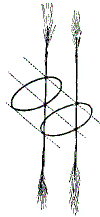 Fig 27A. Fig 27A.
Portion of Framework of Tail.
|


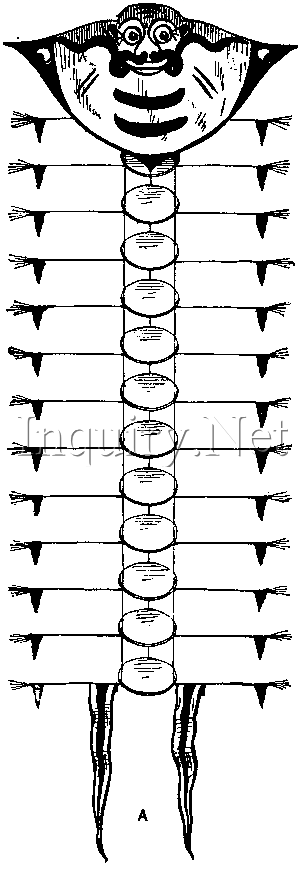 Fig. 27.


Комментариев нет:
Отправить комментарий